Range Repair
Wolf Range Manual: Finding the Right Guide, Parts and Warranty
Find your Wolf range manual by model number: on DF, GR and IR ranges the serial tag sits at the bottom right of the control panel with the oven door open. Look up that exact model's use and care guide, then use it to match parts, check the warranty and spot recalls.
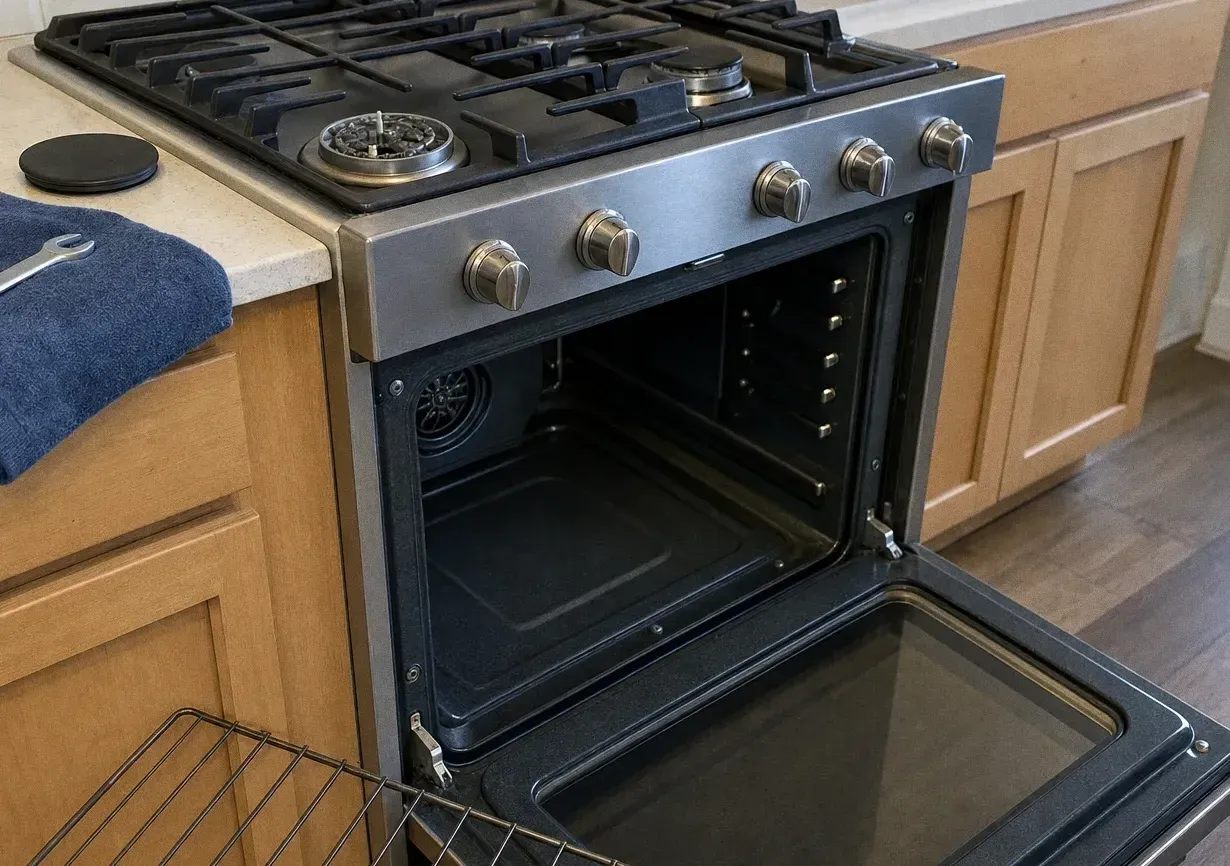
The quickest route to the right Wolf range manual is the model number. With the oven door swung open, check the lower right corner of the control panel: DF dual fuel, GR gas and IR induction ranges all carry their serial tag there, printed with the full model and serial. Search that model on Wolf’s own website and you get the use and care guide, the installation guide and the parts references for your exact range, not a cousin with a different width or burner layout.
If your Lexington house came with its Wolf range already installed, the booklet from the box may be long gone, and a manual for the wrong fuel or generation points you at the wrong part. Below: reading the tag, burner adjustment, genuine versus copied parts, and what the warranty comes down to.
Read the serial tag before anything else
Wolf model numbers are short codes. The opening letters name the product: DF for dual fuel, GR for all-gas, IR for induction, SRT for a sealed burner rangetop. Extra letters flag a griddle, double griddle, charbroiler or French top, and a model ending in -LP was built for propane.
Current DF, IR and GR ranges, plus SRT rangetops, keep the tag in that lower right corner of the control panel. Older generations differ: on R Series gas ranges and RT Series rangetops, lift the grate and the left-hand burner pan, and the tag is on the burner box wall beside it, on the left.
Unsure of the generation? Look at the grates and the light switch. Sealed burners sharing a grate in pairs, with a stainless push-button for the light, mean a GR. Open burners, one grate apiece and a black toggle mean an R Series, which takes a different manual and different parts.
The tag and rating plate also tell you the fuel: NG or NAT for natural, LP for propane. Whoever converted a range should have left a second sticker beside the original naming the new fuel. Photograph all of it; every later step uses it.
What the manual says about burners, and what it leaves to service
People hunting for a Wolf range burner adjustment manual are usually chasing a flame that looks wrong: too tall on low, lifting off the ports, or a simmer that keeps going out. The use and care guide covers burner construction and cleaning, and that alone settles more of these than you might expect.
On a GR, each burner is dual-stacked, one assembly holding all its parts, with the simmer flame running from an upper tier of the cap. Don’t worry if the back left burner looks smaller: it is rated 9,200 Btu against 15,000 Btu for each of the rest. In the oven below, 30-inch and 36-inch cavities bake on 30,000 Btu and broil on 18,000 Btu, while an 18-inch cavity has just its 18,000 Btu bake burner. Propane versions lose none of that.
What an owner can safely do: lift off the cap, wash it and the burner base, let both dry completely, and reseat the cap so it sits flat. A cap that rocks gives a ragged flame and can keep the igniter clicking; our write-up on a burner that clicks without stopping follows that symptom further.
The manual leaves low-flame valve adjustment, orifice changes and fuel conversion to service, and Wolf wants a technician doing any swap from natural gas to propane or back. For DF3050-DF6050 dual fuel models, kit 829533 takes the range to LP and kit 829536 returns it to natural gas. Only the griddle gives anything up on propane: 2,000 Btu. Natural gas units at elevation have their own kit, 829280, though Wolf says that is rarely called for.
Genuine parts or a close copy
Once you know the model, its parts references, or the number stamped on the old component, tell you what fits. Copies of Wolf igniters, valves and orifices are sold online, and some look identical. The differences sit where gas appliances are unforgiving: orifice size for the fuel and Btu rating, electrode shape and spark gap, connectors that seat firmly. A nearly-right part can mean a lazy flame, three tries to light, or a soft thump on ignition.
One Wolf part deserves a check in every kitchen. Wolf wants an anti-tip device on every range, and for current Dual Fuel and Induction models the kit is 829936, using bolt 9027407 and washer 6240050. Its bracket travels in the foam wedge of the cavity kit box inside the oven, so it is easy to throw out with the packaging. If the range came out during a renovation and the bracket never went back, fix that first.
Factory-approved parts cost more than generic ones, but they match the model on your tag. Typical ranges in this area: $250–$1,020 for burner valve or orifice service, $290–$610 for an igniter or spark module, and $530–$1,530 for a control board or touch panel. The firm price follows diagnosis.
What warranty coverage usually comes down to
Wolf’s residential limited warranty starts at installation rather than purchase, so keep the installer’s invoice with the manual. The five-year part of it reaches:
- gas burners, though not how they look
- the blower motor in a hood
- heating elements on the electric side
- induction generators and magnetron tubes
- electronic control boards
Labor and every other cost fall to the owner under that coverage. The warranty document for your range has the complete terms.
A claim usually rests on three things: a provable installation date, a range set up correctly for its gas type, and a failed part on that list. A converted range missing its conversion sticker is where questions start.
Before you put the tag away, check it against CPSC recall 25-034 of November 07, 2024. It applies to Wolf Dual Fuel ranges fitted with infrared griddles, DF36450G/S/P among them, in two serial spans: 18517201 to 18868311, and 10006001 to 10006009. A spill on an affected range can cause a short that turns the griddle on by itself. If yours is inside either span, stop using the griddle and contact Wolf about the recall.
When the manual runs out
If you have the right guide, the caps are clean and seated, and the fault remains, call a technician. Wolf Repair Lexington is an independent shop working on Wolf ranges, ovens, cooktops and hoods in Lexington Center, East Lexington, Meriam Hill and Bedford. The first visit is a $95 service call, which pays for the trip and the whole diagnosis; go ahead with the repair and that $95 is deducted from it. The range repair page covers burner, igniter and oven faults. Call (781) 604-1175 or book online, with the model and serial from the tag to hand.
Still asked on the phone
Is there a Wolf gas range manual for burner adjustment?
Partly. The use and care guide shows how the burners are assembled, cleaned and reseated, but low-flame valve adjustment, orifice changes and fuel conversion are service work, and Wolf wants a technician on any switch of gas type. If a clean, flat-seated cap leaves the flame unchanged, the valve or orifice needs a technician.
What parts does the Wolf range warranty cover for five years?
Counting from installation day, five years of Wolf's limited warranty reach gas burners apart from their looks, electronic control boards, induction generators, magnetron tubes, the blower motors in hoods and electric heating elements. Labor and other costs stay with the owner. Keep the installer's invoice, because that date starts the clock.
Where is the serial tag on an older Wolf R Series range?
Lift the grate and the left-hand burner pan on an R Series gas range or RT Series rangetop, and the tag is on the burner box wall to the left. Newer DF, GR and IR ranges put it in the lower right corner of the control panel, seen with the oven door open.
Can I use an aftermarket igniter on my Wolf range?
It may fit, but a part matched to the model number on your serial tag is the safer choice, since electrode shape, spark gap and the connector all decide whether a burner lights cleanly. A typical igniter or spark module replacement runs $290–$610, with the firm price given after diagnosis.